By Hunter Ferguson
The Harlem Renaissance – from the 1920s to the mid-30s – shifted the world’s consciousness. There was a renewal of black life, thought, leadership & possibilities. What’s known as the Roaring Twenties was a decade of economic prosperity, jazz, radio, automobiles, women’s rights, and the prohibition.
The Great Migration brought millions up north, turning Harlem into a cultural and economic center. Blacks from the South and the Caribbean arrived in search of opportunity and escape from Jim Crow. In 1910, Blacks in Harlem made up roughly 1 out of 10 residents. Ten years later, nearly one-third of the population, and by 1930, more than 70%!
This growth fueled new Black-owned businesses, and with more people, meant a demand for arts, housing, entertainment, dining, newspapers, fashion, cultural organizations and retail shops that all catered to the community. This circulated wealth, and challenged the racial limitations placed on black Americans. Rent parties, Connie’s Inn, the Savoy Ballroom, and the infamous Cotton Club all became symbols of Black determination.
The writers W.E.B. Du Bois and Alain Locke pushed for what they called a “New Negro”, a confident, self-defined, and unapologetically expressive person. Du Bois was the editor of the NAACP magazine, The Crisis, which published and promoted Black artists. One of Du Bois’s most famous books, “The Souls of Black Folks”, became a foundational text for this futuristic mentality.
The Savoy Ballroom opened on Lenox Avenue. Unlike the Cotton Club, the Savoy Ballroom was one of the first major public dance halls in the country to adopt an integrated policy, and practice non-discrimination from the start. People of different races, classes, and backgrounds all danced side–by– side.
The Cotton Club, also on Lenox Avenue, took a different approach – catering to only white audiences. The venue fantasized the black experience, showcasing brilliant talents like Bill “Bojangles” Robinson, Duke Ellington, Cab Calloway, and Lena Horne, who all launched their careers on the stage. Black performers were celebrated, but banned from entry. Even the club’s décor and food menu reinforced racist stereotypes, selling a fantasy of the Old South to its white clientele.
Behind the scenes, the club was deeply tied to organized crime. Gangsters used the Cotton Club to launder money from bootlegging alcohol during the Prohibition.
The following will not be a comprehensive account of every voice or contribution. Instead, I will offer a taste into the lives of some of the people who shaped the era that made Harlem a cultural capital of the world, improved the economy of Black communities, challenged political systems, and opened dialogue around identity, sexuality, and freedom.
Cab Calloway got his break in a show called “Plantation Days”. Once he started building his reputation, within a few years, he opened at the Cotton Club. These shows were one of the 1st to be nationally broadcast on radio, and this elevated him as one of the biggest names in show business.
Cab was perfect for the emerging medium of film at that time, setting a standard of music performances on screen & animation which he trailblazed. Most famously, he made his impact by incorporating “call and response” elements in his music. His 1931 hit song, “Minnie the Moocher”, resulted in him being the 1st black artist to sell over 1 million records!
This wasn’t just an artistic movement, it was a sexual one, too. Black queer Americans had a space to create, gather, and exist with fewer restrictions than anywhere else in the country. These artists faced pressure to censor themselves, or hide their identities, but refused to do so. For example, the “Hamilton Lodge Ball” was a drag show, which drew thousands of people.
Two women who pioneered their sexuality & talent – unapologetically – were Ma Rainey & Bessie Smith, who would become one of the biggest names in blues.
In 1928, Ma Rainey wrote a song titled “Prove It On Me Blues”, which was a song about her sexual preference. Beyond stating that she doesn’t like men, the lyrics celebrate her choice to wear a collar shirt or tie, and talk to women like any other man would.
Ma & Bessie weren’t women to be played with. Along with their talents, both were known for speaking their minds, and weren’t afraid of altercations, man or woman!
Bessie Smith once fought off a group of KKK members in North Carolina who were trying to destroy tents at her show. On another occasion, she was stabbed for beating up a man who was harassing her niece. She was rushed to the hospital, but left after a few hours to perform a show the next day!
After she parted ways with Ma Rainey, Bessie’s big break occurred in 1923, when she signed with Columbia Records, and released her first hit single, “Downhearted Blues”. The record was explosive, and by the next year, her total sales surpassed two million records. This launched her into the national spotlight, making her the highest-paid Black entertainer of her time.
Count Basie, born as William James Basie, absorbed Harlem’s energy through the clubs, rent parties, and theaters. When Basie first moved to Harlem as a young musician, he lived near the Alhambra Theater. His first steady gig was at a club called Leroy’s, a place known for its piano players and “cutting contests”, which were friendly musical battles, where pianists showed off their improvisational skills. During this period, Basie was influenced by other Harlem pianists like Fats Waller, Willie “The Lion” Smith, and James P. Johnson.
Count Basie’s big break came in Kansas City, where he formed his own band. Their music was raw, and driven by rhythm rather than strict arrangements. Basie’s leadership motivated his bandmates beyond jazz into a confident expression of freedom. This approach set Basie apart at a time when many big bands relied on orchestration.
As a bandleader, he earned their respect, not only through his talent, but with his humanism.
Basie truly lived that Big Life. He was married to Catherine Morgan Basie, who was a prominent community organizer and activist, and who later worked alongside Martin Luther King, Jr. Their daughter, Diane, was born with cerebral palsy. Doctors believed she would never walk, but she did, eventually learning to swim, too – all from her parents’ support. Diane was described as the “hidden core” of Basie’s creativity; he was very protective of her, and often wrote letters to her while touring.
Art Tatum, who grew up in Toledo, Ohio, was nearly blind from childhood, but possessed superhuman ears. Coming on the scene in the early 1930s, after moving to Harlem, he also participated in those piano “cutting contests.” The story goes that once Tatum sat down, no one else would play afterwards. His legacy was virtuosity & innovation. He was a major influence on pianists Oscar Peterson, Thelonious Monk & Herbie Hancock. Even classical pianists studied him in secret, including Vladimir Horowitz and Sergei Rachmaninoff, two of the greatest classical pianists ever. Rachmaninoff famously said: “If this man ever decides to play classical music, we’re all in trouble”!
Three women whose talents spanned comedy, literature, music, and theater were: Moms Mabley, Zora Neale Hurston, and Ethel Waters. Together, they helped shape the era.
Moms Mabley became one of the most popular comedians of the time. She paved the way for women in stand-up comedy, and redefined black female expression. Behind the comedy was razor-sharp social commentary.
Zora Neale Hurston, known as the Queen of the Harlem Renaissance, was a novelist and anthropologist. Hurston framed Black life through language, folklore, spirituality, and humor to tell her stories. As a central literary voice of the era, she documented southern black life and womanhood with beauty. Her masterpiece, Their Eyes Were Watching God, was included in Time magazine’s 2005 list of the 100 best English-language novels ever published.
Ethel Waters is known as the voice that carried the Blues to Broadway. She rose from poverty to become one of the most celebrated singers and actresses of her time. Waters helped legitimize Black musical artistry within mainstream American culture. As Harlem’s artists thrived in jazz clubs, she elevated Black performance into respected theatrical spaces. Her success pushed racial barriers, and expanded opportunities for Black performers in both music and drama.
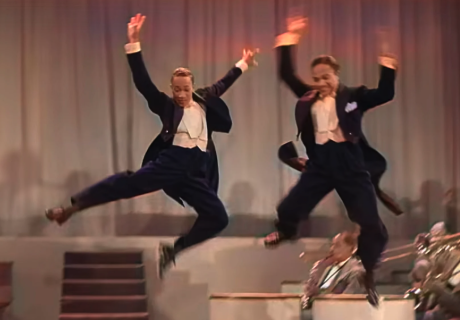
The Nicholas Brothers, Fayard and Harold were more than dancers; they changed the game. Fayard was 18 years old, and Harold just 11 when they premiered at the Cotton Club in 1932. They moved with maturity and excitement, which made their precision, timing, and acrobatics even more phenomenal!
They grew up backstage because their parents were musicians working in vaudeville theaters. Without formal training, they taught themselves to dance by studying what they saw. They didn’t just tap dance, they soared! Splits in midair! Flips over each other, landing in perfect time! The Nicholas Brothers were innovative. Just as Langston Hughes and Zora gave voice to Black experience through poetry, and musicians like Art and Cab reshaped American sound, the Nicholas brothers redefined what the human body could do.
Globally, they were celebrated as cultural ambassadors of American jazz and dance, and in 1991, they received the prestigious Kennedy Center Honors, recognizing their lifetime contribution to American culture.
In the film Stormy Weather, the Nicholas Brothers delivered one of the greatest dance sequences ever filmed.
Oscar Micheaux was the first major African American filmmaker, and one of the most prolific independent directors in film history. He wrote, directed, produced, distributed, and even promoted his own films. A one-man studio!
He created over 40 films between 1919 and the late 1940s. Sadly, many are lost. But his 1920 film, “Within Our Gates”, is his most famous surviving film, which was a direct response to the infamously racist film, The Birth of a Nation, from 1915. Micheaux’s films addressed colorism, corruption, class tension between southern and urban life, sexual politics and gender power. This is what made him radical, not just representing, but arguing, too. He didn’t care to comfort anyone – black or white.
He pioneered black filmmakers owning their narratives. Without Micheaux, there is no clear path for directors Spike Lee, John Singleton, Julie Dash, Ryan Coogler, or Issa Rae.
The silent film, Body and Soul, featured the emerging star Paul Robeson, who played dual roles: a corrupt preacher, and his honest twin brother. Robeson went on to star in 13 films.
Though Body and Soul is historically huge and was Robeson’s first film role, Robeson later disliked it. He felt the portrayal of the preacher reinforced negative stereotypes about blacks. During the Harlem Renaissance, there were disagreements about survival, power, and strategy within the black community. Like Robeson, some believe that art should counter racist stereotypes and show “the best” of black life.
Others like Micheux felt realism was more important. If the art projects fantasy to protect the race, it stops being art. This was a defensive strategy to avoid criticism that could be used by racists. It was an intense dispute about how the black community was portrayed in entertainment.
Paul Robeson is a man many people know little about. Born in Princeton, NJ in 1898 to a once– enslaved father, he learned from the beginning to embrace a radical, rebellious & political spirit. A pioneer as one of Rutgers University’s first Black students, and its first Black football player. He also led academically, and was a star athlete achieving two-time All-American football awards, and was equally great at basketball and track. After graduating at the top of his class, he played professional basketball and football in the first NFL season to help pay his way through Columbia Law School.
Robeson tried to practice law, but when a white secretary refused to take dictation from him, he learned that law wasn’t for him or his people. In the entertainment industry, there were more possibilities. He lived in Harlem for many years, collaborating with W.E.B. Dubois and Langston Hughes, and where he even met his wife, who pushed him towards the arts and his mission. One of his earliest lead roles was part of the vocal quartet of the 1921 musical “Shuffle Along” by Eubie Blake and Noble Sissle, which was the first musical written and performed entirely by a black cast. Robeson would go on to become a legendary bass-baritone singer, and a legendary actor in Shakespeare’s “Othello”.
He sang black spirituals, work, & folk songs from around the world, and even classical pieces sung in their original languages. He learned French, Italian, German, Spanish, Chinese, Dutch, Hungarian, Turkish, Swedish, Norwegian, Czech, Modern Greek, Ancient Latin, Portuguese, Russian, and Yiddish! African languages, too!: Yoruba, Yu, Efik, Benin, Ashanti, Swahili, Chuuwee, Tiv, Ga, Hausa and others! Robeson made more than 200 recordings, and was beloved all over the world.
His performance of “Ol’ Man River” in the film Show Boat is among the most iconic moments in film musical history. Robeson famously altered the lyrics from a subservient POV into an anthem of resistance, and Black strength. He changed “I’m tired of livin’ / And scared of dyin'” to “I must keep fightin’ / Until I’m dyin'”. And he changed “Ah gits weary / An’ sick of tryin'” to “But I keeps laffin’ / Instead of cryin'”.
The 1933 movie “Emperor Jones”, starring Robeson, is the first mainstream film to feature a black actor who was billed above his white co-stars. It positioned him as the first African-American leading man in mainstream U.S. cinema.
Robeson was never comfortable with Hollywood’s racial limitations. His roles usually were black stereotypes, and he openly criticized them all. Eventually he announced that he would stop performing to focus on fighting against injustice.
Because of his outspoken criticism of the United States government, he was blacklisted, and became a prisoner in his own country when his passport was revoked for 8 years.
Robeson was as radical as they come. The CIA & FBI had it out for him. In their eyes he wasn’t an artist but a national problem. The FBI opened a massive file on him, of thousands of pages. His phone calls were tapped, his mail was opened, and informants were planted in audiences with the aim of discrediting and silencing him. Because Robeson refused to retreat, he performed by telephone and radio to audiences overseas. After his passport was taken away, he gave several concerts in which he sang and spoke across the U.S. & Canada border in Washington State to a crowd of 40,000 gathered on the other side!
After multiple attempts on his life, his son was convinced that the CIA poisoned Robeson with mind-altering drugs at a party in Moscow. The next morning he was found in a pool of blood in his bathroom with both wrists cut. Afterwards, he went through 56 electroshock treatments, and was prescribed 23 drugs, all of which dramatically damaged his brain. Robeson wasn’t targeted because he was disloyal, but because he refused to shrink and give in to a country that denied his humanity.