Biblical Cantillation, the Modes of Prayer, and Congregational Song
The Music of the Synagogue – Intro
The Music of the Synagogue is, in my view, where Jewish Music really begins. In its association with the Hebrew prayers and the Hebrew Bible, it is separate from the more secular forms of music and song which have come to define much of Jewish Music. But even secular forms of Jewish music are, at their root, associated with life passage events, such as weddings, Bar and Bat Mitzvahs, and communal celebrations. It is not the intent of this program to label what styles of Jewish music are more or less authentic. But rather, my view is that Jewish Music is defined, whether in the recent or distant past, by an association with Jewish ritual.
Let me say, at the outset, that the music in this program is mainly from the Ashkenazi, or Western, Jewish tradition. However, the uses of Music in the Synagogue apply equally to all Jewish denominations – Ashkenazi (or Western), Sephardi (or Mediterranean), and Mizrahi (or Eastern).
The two main traditional uses of music in the synagogue are: Biblical Cantillation and the Modes of Prayer.
Biblical Cantillation
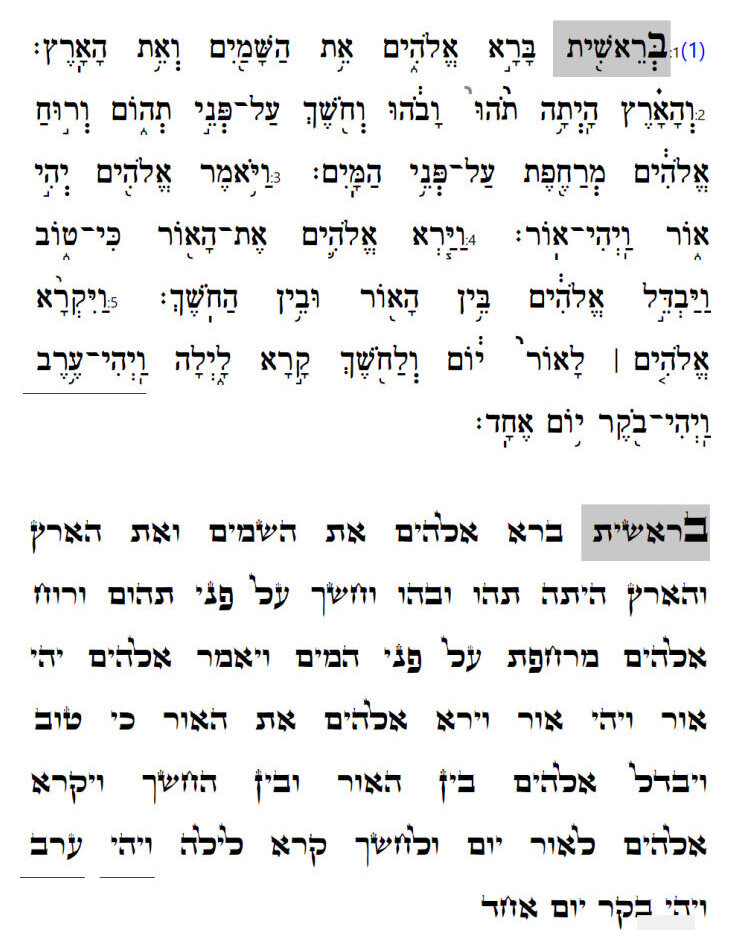
(1) B’reishit bara Elohim et hashamayim v’et ha-arets.
(1) In the beginning God created the heaven and the earth.
(2) V’ha-arets hayta tohu vavohu v’khoshech al pnei t’hom, v’ruakh Elohim m’rakhefet al pnei hamayim.
(2) And the earth was without form and void and darkness was upon the face of the deep, and the spirit of God moved upon the face of the waters.
(3) Vayomer Elohim y’hi or, vay’hi or.
(3) And God said Let There Be Light, and there was light.
(4) Vayar Elohim et ha-or ki tov, vayavdel ben ha-or uven hakhoshech.
(4) And God saw the light that it was good, and God divided the light from the darkness.
(5) Vayikra Elohim la-or yom, v’lakhoshech kara layla, vay’hi erev vay’hi voker yom ekhad.
(5) And God called the light Day, and the darkness he called Night, and the evening and the morning were the first day.
What you see written above, is the text of none other than the opening verses of Genesis, known in Hebrew by the first word of the text, B’reishit, which means, ‘in the beginning’. We see here the Hebrew script, but with all kinds of markings above and below the words. These markings are, first of all, the vowels that go with the Hebrew consonants; and secondly, certain markings that are additional to the vowels. These additional markings are known as Biblical Accents or, in more common parlance, Trop. The trop represent the melodies to which the text is chanted.
Let me back up a bit.
The system of signs for biblical cantillation were codified around the 9th century CE (or Common Era – known in the West as AD), by a certain Aaron ben Asher. He was one of those known as the Masoretes – groups of Jewish scribe-scholars who worked from around the end of the 5th through the 10th century CE. Ben Asher belonged to the Tiberias school, and it is this school that gave the Hebrew Bible its final vowelling, its pronunciation, as well as the trop or biblical accents. Biblical accents are known in Hebrew as T’amim. In this talk we will predominantly use the term Trop in speaking of the biblical accents, but interestingly, the Hebrew word t’amim is a plural form of the word ta-am, which literally means ‘taste’. Thus, the trop, the t’amim, are the ‘taste’ of the written scripture. The aim of the trop has always been to clarify the text, and to help communicate its meaning. The trop parse the sentence into clauses and sub clauses, and serve as a secondary punctuation of the text, as it were.
Let’s look at the text a bit more. The top paragraph is the Hebrew text with all vowels and trop, but just below it is the Hebrew text as it appears in the Torah scroll itself. The Torah scroll is a beautiful calligraphic rendering, on parchment, of the 5 Books of Moses, namely, Genesis, Exodus, Leviticus, Numbers, and Deuteronomy. In the Torah scroll itself, the script appears without any vowels or trop, as the reader in the synagogue is required to know all the vowels and trop by heart. This explains why, in the traditional synagogue, the Torah reader is a ‘professional’, preparing all the readings throughout the year – not at all an easy task to accomplish with the great degree of accuracy required.
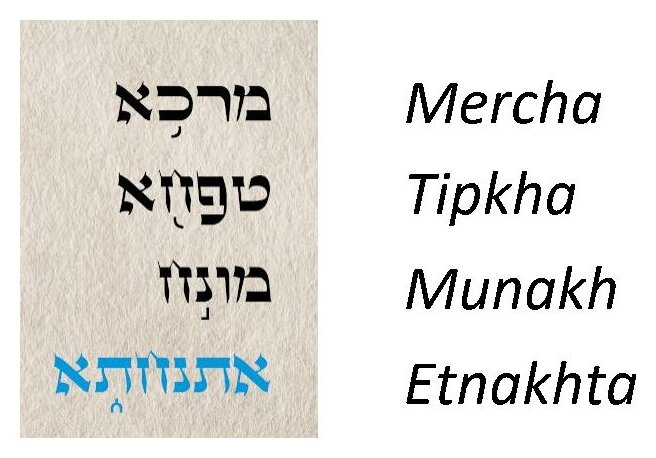
The trop themselves have names. This is a picture with 4 very common trop;
mercha
tipcha
munach
etnakhta
Under their names are markings – these are the trop markings which are appended to the words in scripture.
Of course, there are many more trop being utilized in the chanting, but from this quick study perhaps you can obtain an idea of how the system of Biblical Cantillation works.
It is important to know, at the outset, is that it is the text that is paramount, not the music, as lovely as the melodies may be. Thus, to read Torah, the reader does well to learn to read the text first, and understand what he or she is reading, before adding the trop. Missing a trop here and there is not hardly as egregious an error as mispronouncing a word, or not parsing a sentence correctly. The trop enhance the meaning, and are a wonderful way to call attention to the reading, but they are not the essential matter. The text is always primary.
About the music of the trop, it is important to understand that the trop are a consistent system of markings, but without universally fixed melodic equivalents. In other words, there are many variants of the melodic interpretations of the same trop. What you just heard is my own tradition, but there are others as well. What the ‘original melody’ utilized by Aaron Ben Asher and his Masoretic colleagues sounded like, we do not know, as the melodies were not notated. But then again, the melodic content is not random, but follows the function of the trop. To give two simple examples, there is an end of verse trop (called in Hebrew Sof Pasuk), and a resting trop (called Etnakhta) to end a sub-clause in mid-verse. So whatever music is composed for these, it would have to be a kind of half cadence for the Etnakhta and a completion for the Sof Pasuk.
As I have explained before, there are several musical traditions in Jewish music, the Ashkenazi or Western, the Sephardi or Mediterranean, and the Mizrahi or Eastern. My tradition is an Ashkenazi, or Western one, but even among the Ashkenazim there are melodic variations for the trop. And there are various trop-melody systems in Sephardi and Mizrahi cantillation traditions as well. The things common to all these melody systems are 1. The Hebraic vowelling, and 2. The trop markings themselves. The melodic interpretations of the trop developed in different communities, and their precise origins are not known. It has always been an oral tradition, though today many of the melodies have been notated for learning purposes.
Different Trop for Different Scriptures
The Torah (or the Five Books of Moses) is not the only scripture that is chanted in the synagogue with the aid of trop-melodies. In fact, there are different trop-melody sets, depending on the scripture being chanted. Thus, there is a system of trop melodies for the Torah reading, but another one for what is known as the Haftarah, which is the reading from the prophetic books. This reading follows the Torah reading on the Sabbath, and on Holidays. There is also a different trop-melody system for the High Holidays – Rosh Hashana, the Jewish New Year, and Yom Kippur, the Day of Atonement. And then there are other trop-melodies for the reading of the various canonical scrolls: Megilat Esther, the Scroll of Esther, which is read on Purim, and Lamentations which is read on the Ninth of Av, a significant fast day. As well, there is another set for the other canonical books: Ruth, the Song of Songs, and Ecclesiastes.
You may have gathered from all these variations that Jewish people do not like to keep their music as a straightforward and simple matter, ha ha, but more seriously, that there is a richness to the synagogue’s musical traditions.
The most common trop-melody sets chanted in the synagogue are the ones utilized for the Torah (the Five Books of Moses), and the Haftarah (the Prophetic writings). There are such readings on every Shabbat (the Sabbath Day).
There is a difference in mood, or if you will, mode, between the trop-melodies heard in the chanting of the Torah, and that of the Haftarah. Indeed the Haftarah has a melody which is more somber, even sadder, than the melody of the Torah reading. Remember, the trop being utilized look exactly the same, but the melodic interpretations of them are different.
When we speak about the modes of prayer in the next section, the more ‘major key’ sound of the Torah trop-melodies are referred to as Adonai Malach (literally, ‘God Reigns’), and the more ‘minor key’ sound of the Haftarah is referred to as Magen Avot (literally, ‘The One who Protects the Ancestors’).
One last thing to say about the trop for the Haftarah, is that the reader is permitted to see the words with all the vowels and trop. This makes it easier than reading from the Torah scroll itself, where the reader is obliged to know all the vowelling and trop markings from memory.
Regarding biblical cantillation for the Torah portion, I would also like to mention a system of hand signs for the trop which can be utilized to help the reader of the Torah portion.
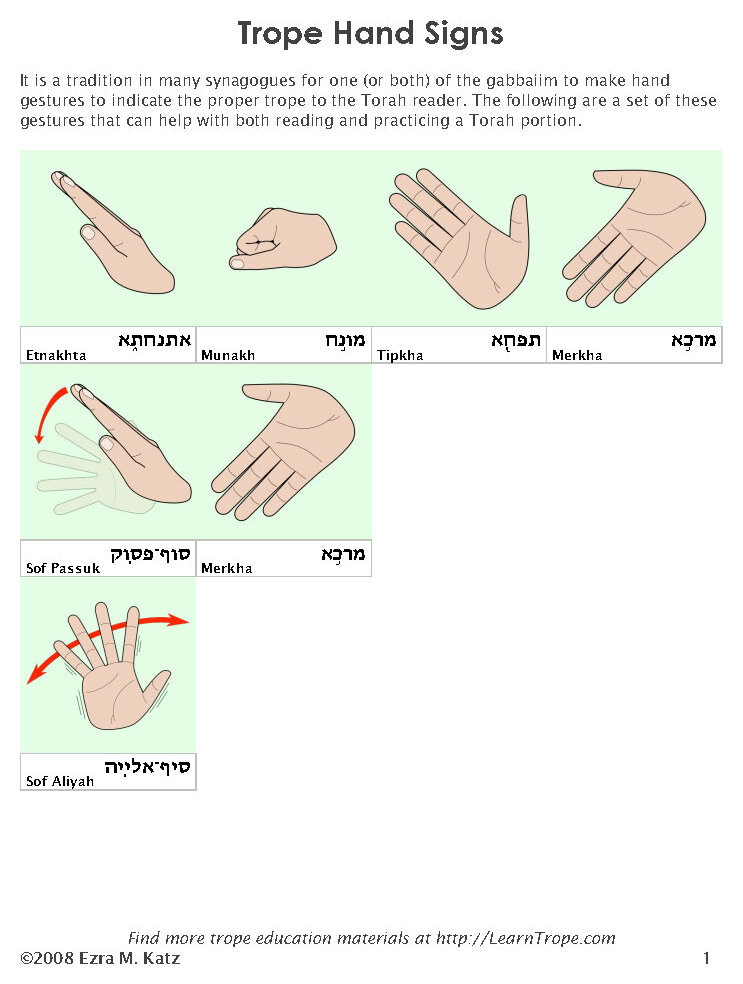
These hand signs can be very useful for a reader who has not learned the trop by heart 100%. Personally, I think they could be very useful in many synagogues today, where the specialization of reading Torah with all trop intact has become less of a priority. However, to my knowledge, these hand signs are hardly utilized.
Finally, I’d like to make clear that this system of T’amim or Trop, is a Jewish invention, borne of the need to clarify and enhance the meaning of the biblical text. It is not borrowed from a non-Jewish source, to the best of my knowledge.
To summarize then, Biblical cantillation serves an important function in clarifying and beautifying the biblical text. The markings, called T’amim or Trop, are found above and below the words, and are consistent throughout the Jewish world; however, the melodic interpretations of the trop may vary significantly between communities and between different scriptural readings for different occasions.
The Modes of Prayer
The Modes of Prayer are those melodies, cadences, and melodic formulas utilized by the cantor in leading the services. Of course, the congregation is encouraged to sing along with the cantor, and any good cantorial soloist will make sure to use the traditional melodies that the congregation knows and can sing. This is to fulfil a central aspect of his function, which is to involve the congregation in the prayers.
The Modes of Prayer, sometimes referred to as Nusakh Tfila (which means: ‘formulation of prayer’), are utilized to create musical moods whereby the prayers are enhanced and given a musical context. Just as there are different melodies for different biblical readings, certain modes of prayer have been traditionally applied to certain prayers and certain services. For anyone who has frequented the synagogue, you undoubtedly have felt the marked difference between the modes and melodies utilized on the High Holidays and those sung on the Sabbath, for example. So, melodic formulas and cadences vary depending upon the prayer and the service: The prayers for bringing in the Sabbath, for the Sabbath day itself, for the Sabbath afternoon service, for the various Holidays, for the High Holidays and for weekday services – all these may have traditional modes and melodies associated with them. While the traditions change over time, the traditional formulations (or Nusakh) are very strongly adhered to for years and generations.
In anticipation of the age-old question ‘What is a Mode?’, and how it differs from a Scale, here is a quick explanation as it pertains to the system of modes in Jewish Cantorial music. A scale is a collection of notes, organized in an ascending or descending manner, while a mode is the way or manner of organizing the notes of a scale into melodic combinations. A mode utilizes certain typical melodic formulas for opening and closing a piece, and abides by certain rules governing the emphasis on one or another note or groups of notes. Thus, a scale is simply a template from which modes and melodies are made.
We shall be touching upon 4 basic modes today, which are known by the following names:
Adonai Malach (God is Sovereign), Magen Avot (The One Who Protects Our Ancestors), Ahava Raba (God’s Abundant Love), and Misheberach (The One Who Blessed Us).
As I pointed out previously, the two modes associated with chanting Torah (The Five Books of Moses) and Haftarah (The Prophetic Writings), are respectively, Adonai Malach, and Magen Avot. Let’s take the first mode, Adonai Malach.
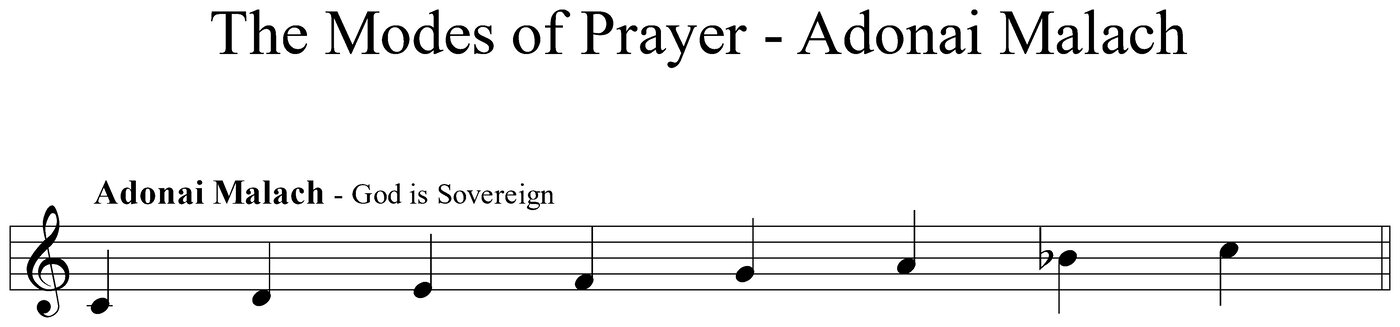
Adonai Malach, literally God is Sovereign, is a mode associated with texts voicing divine praise. One may associate it with the Western mode called Mixolydian.
Now let’s touch upon Magen Avot, literally ‘The One Who Protects Our Ancestors’. This mode is also known as the didactic mode, as it is associated with readings that teach something. The actual prayer, Magen Avot, is sung on the eve of the Shabbat (the Sabbath), and the text teaches the relevance of Shabbat observance. One may associate it with the Western mode known as Aeolian or Natural Minor.
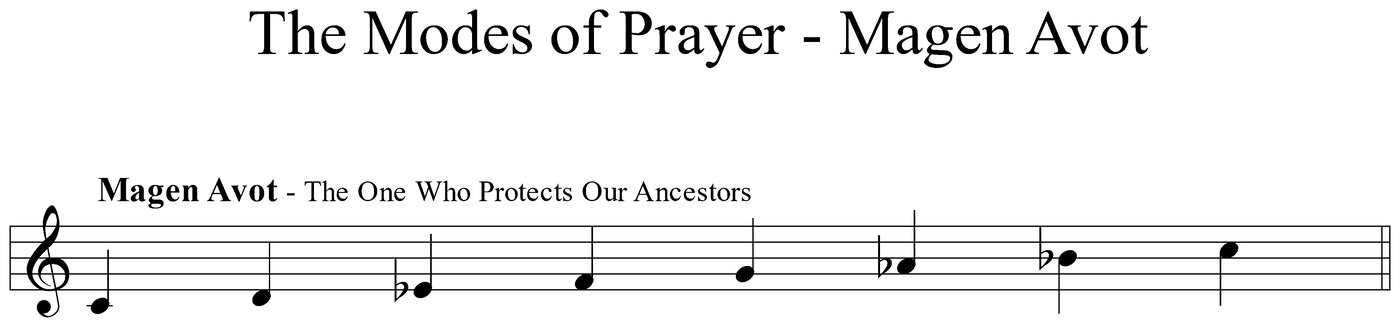
There are a great many familiar tunes that utilize Magen Avot.
The central thing to understand about the modes of prayer is that the art of cantorial singing, or Hazzanut, moves from one mode to another, even within the same prayer, in order to express the different aspects of the prayer.
For example, when we recite Kiddush, the Benediction over Wine, after Sabbath morning services, we begin with the text V’shamru (the Children of Israel kept the Sabbath) in Magen Avot, and then complete the benediction with the blessing over wine declaring the sovereignty of God, in Adonai Malach.
Next, we come to the mode of supplication, Ahava Raba (God’s Abundant Love).
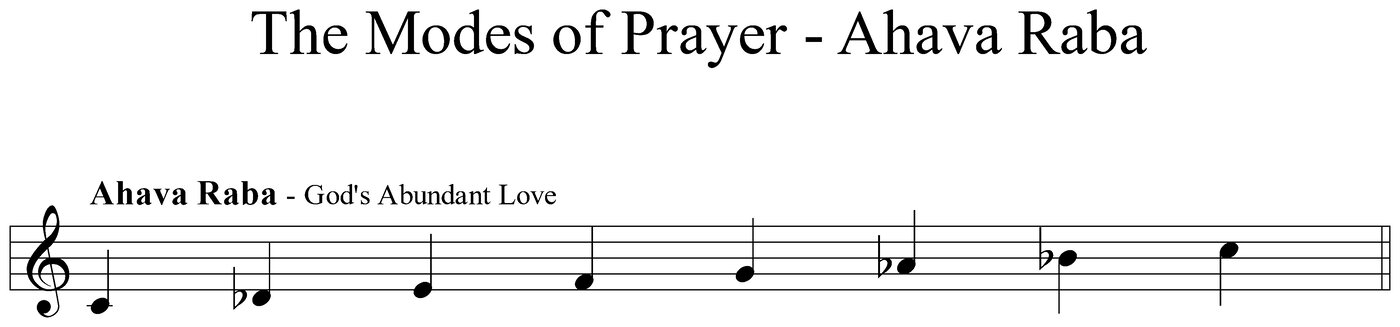
This mode is very Ashkenazi, but has very strong middle-eastern and Arabic equivalents and references. We sometimes jocularly call it the ‘Hava Nagila’ mode, mainly because this famous song is in this mode. In Arabic music it is often known as Hijaz. This mode is not connected to biblical reading, it is a naturalized import, but has become central to the identity of cantorial singing and prayer. It is used extensively for Shabbat Morning Services, and it has its uses in many services during the Jewish year. A lot of congregational chanting is done in this mode.
There is one more mode that I will mention. It is called Misheberach (The One Who Blessed Us). I associate this mode also with supplication, and indeed it plays a very important role in the high holiday services.
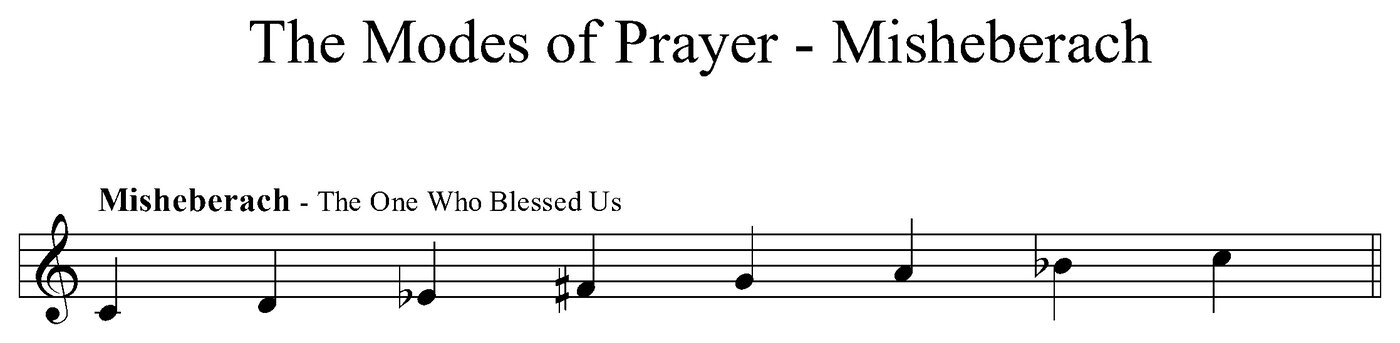
To summarize, the traditional modes of prayer, in the Ashkenazi tradition, are associated with specific prayers and services, and a great many congregational chants as well. These modes give a sense of context, they colour the texts with familiar melodic materials, and have become inextricably intertwined with the services for which they are utilized. It does not mean that other modes – for example from the folk music of the surrounding culture – cannot ever be utilized and naturalized, but the traditional modes of prayer, over time, have developed a deep meaning and a lasting association with synagogue worship.
Congregational Song – the very Home of Jewish Music
Have a look at this diagram of Jewish Music. As mapped out here, Jewish Music can be either devotional or secular, depending on its content and function.
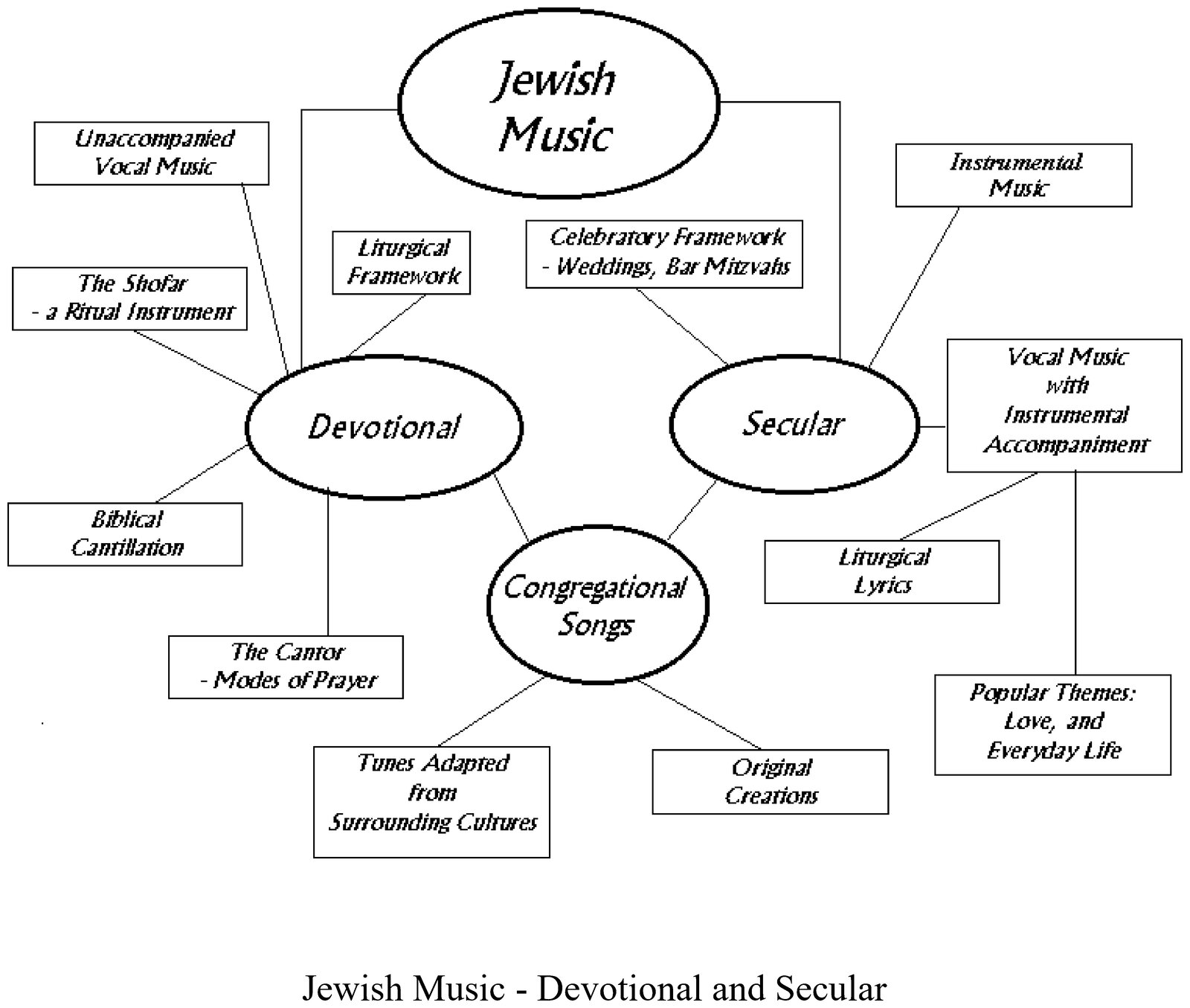
The devotional category is comprised of the following:
1. Music for Synagogue Worship – Included here is what we just spoke of, namely, the art of the Cantor who utilizes specific modes and melodies, and the art of Biblical cantillation, with its ancient tradition of trop.
2. Other Religious Music – Melodies utilized to heighten devotional fervour, especially the melodies of the Hassidim; also, religious poetry, sung in the Synagogue or at home.
One of the main features of Devotional Music, especially when utilized in Synagogue ritual on the Sabbath and other holy days, is that it is almost entirely vocal. Though today, in certain Jewish denominations, accompanying instruments such as the organ or the guitar are utilized in worship, the emphasis on congregational song and the art of the Hazan, the cantor, has always been, and still is, paramount.
There is one exception to this, and it is an instrument called the shofar, a ram’s horn which is sounded on the High Holidays (the Jewish New Year and Day of Atonement – Rosh Hashana and Yom Kippur, respectively), as a special call to prayer and repentance.
The shofar is definitely a ritual instrument, though some musicians have found ways to utilize it as part of their compositions.
The secular category is mainly music played at life passage events: Weddings, Bar-Mitzvahs, Bat-Mitzvahs, and other communal celebrations. Both instruments and voice are utilized in this music. It can be very rhythmic and have popular, even romantic texts. One may include in this category all Jewish Folk and Popular Music whose performance lies outside the religious domain.
Most importantly in our discussion of the music of the synagogue, is the age-old Jewish penchant for interchange between the secular and devotional in Jewish music. For example, devotional texts are often used for songs sung and played in a more secular setting; and, on the other hand, tunes from a secular source, sometimes from the music of the surrounding non-Jewish culture, find their way into the Synagogue. Many secular tunes have been set to traditional texts and used in the act of worship.
The interface, as it were, between these two spheres, is the Congregational Song. These are the songs and melodies that perform a dual function – they can be heard both at worship services and at general celebratory events.
Sometimes, using a very popular tune, in the context of prayer services, serves the very important function of having the congregation participate in the services. And by bringing into the liturgical sphere a piece of the outside world, the two worlds are less divided, and this is an important message to those attending services. I would say that this message is: The outside world can also be sanctified by prayer.
The concluding hymn of the Sabbath service, Adon Olam (Ruler of the Universe), can be sung in a more serious manner and also more playfully. Countless original melodies have been written for this hymn, and more than this, many secular tunes have been used to present it. It is a tradition to have fun with, to enjoy this concluding hymn, and so it does not have to be a solemn offering.
So, Adon Olam is often presented with tongue firmly in cheek, just to send everyone off in a happy mood. It can also be done in a more beautiful manner, but if you tune into the presentation on Cesare’s Oasis, you will hear me regale you with my latest jocular take of Adon Olam.
I look forward to seeing you there.