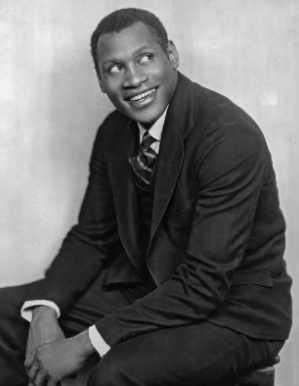
Speaking to the Central Conference of American Rabbis in New York City in 1945, Robeson said: “Since the first days of the American Revolution, Jews and Negroes have fought and died together. Many Jews contributed money to purchase the freedom of escaped slaves. And many Jews distinguished themselves during the war to end slavery. Americans are deeply indebted to the creativity and cultural gifts of the Jewish people. In London and New York, my best friends are Russian Jews.
In my boyhood, I first heard about the epics of Moses and Joshua and Gideon, and the fiery Hebrew prophets that gave imagery to the freedom songs of my people – such as our great Negro spiritual, “Go Down Moses”. The Negro spiritual and the Hebrew chant have the same plaintive note. Both of our peoples have known oppression, and I feel at home singing in Hebrew”, a language he had heard at the knee of his late father.
I remember always being taken by the spiritual – “We Are Climbing Jacob’s Ladder” – as a boy. We are climbing Jacob’s ladder, rung-by-rung, higher and higher, until we find our Freedoms, our complete equality in the lands of our birth.”
At the beginning of 1947, Robeson announced plans to take two years off from his artistic career to travel throughout the nation, and speak out against hatred and prejudice “such battles as I had been part of on the picket lines with the auto workers, the gallant tobacco workers, the longshoreman, cooks and stewards, the furriers, electrical workers, the packinghouse workers; the miners; the steel workers; the furriers, clerks and garment workers.”
In 1947, Robeson sang in Panama to support the workers of the Panama Canal zone. Afterwards, he described the vicious practices of discrimination and segregation.
In 1948, the International Longshoremen’s and Warehousemen’s Union invited Robeson to tour 6 of the 8 Hawaiian Islands. He sang in Chinese, Filipino, Japanese, and Hawaiian, which opened up lines of communication among the various ethnic groups of laborers.
In 1949, Robeson led a meeting of 3,000 protesters in London against the racist policies of the South African government. Robeson criticized the United States’ colonization plans in the Philippines, fearing it would lead to war in Southeast Asia. He denounced US intervention in Guatemala, and loudly protested the continuing persecutions of the Council on African Affairs. In Australia, Robeson spoke out for the rights of the Aborigines.
Robeson stated “What did Soviet Russia ever do for me?” I said, just a minute now. One thing they did for you – in destroying fascism; you remember, you better remember this Hitler again. He destroyed 6 million Jewish people – burned 6 million Jewish people up. He was just hoping to get hold of 10 or 15 million Negroes to burn up. Well, the reason he couldn’t get hold of them happened to be because 10 to 20 million Russians took him.”
After the Supreme Court outlawed school segregation, Senator Eastland declared “The South will retain segregation.” And 100 other senators and representatives from the South signed a manifesto in which they denounced the court’s decision, and pledged that they would resist its enforcement. They saw it as a threat to the “habits, customs, traditions and way of life” of white supremacy. The upholders of the myth of white supremacy have bluntly stated their position: “not now and not ever shall the Jim Crow system be abolished.” I came to see that the struggle against fascism must take first place over every other interest. And I saw, too, that the struggle for Negro rights was an inseparable part of the anti-fascist struggle.
In 1946, Robeson was called to appear before the House Un-American Activities Committee on a charge of affiliating with communist front organizations. He stated that he was not – and had never been – a member of the Communist party.
When his son asked him why he had never joined the Communist party, he replied that he was not willing to submit to the party’s discipline, and that he did what he wanted to do, and said what he wanted to say; he would listen to others, “but I make my own decisions.”
Right after World War II, hundreds of African-Americans returning from the war were being lynched in the South. In the fall of 1946, Robeson led a crusade against lynching. At a political action committee meeting at Madison Square Garden, Robeson asked “What about it, President Truman? Why have you failed to speak out against this evil? When will the federal government take effective action to uphold our constitutional guarantees? The people will now go to Washington themselves for a mighty American crusade to end lynching.” Robeson said “How long, all Lord, how long? – That ancient cry of the oppressed is often voiced these days. How long? The answer is: as long as we permit it. If we unite, we’ll get our law against lynching, and our right to vote. Let us march on Washington, representing 14 million strong. Let us push aside the sycophants who tell us to be quiet.”
Robeson led a delegation to the White House to meet with President Truman. Robeson said that the temper of black people was changing. When Truman asked him to elaborate, Robeson said that if the federal government refused to defend its black citizens against murder, blacks would have to defend themselves. The president stood up red in the face and shook his finger at Paul saying “That sounds like a threat”, and abruptly ended the meeting.
Robeson’s open attacks on Truman isolated him from the black elite. The more conservative African-American leaders took every opportunity to distance themselves from Robeson. Adam Clayton Powell, Jr. stated that “America was making great progress in race relations” and criticized Robeson for echoing communist propaganda. The head of the NAACP, Walter White, and most other leaders refused to back the initiative. However, W.E.B. Du Bois and Albert Einstein joined Robeson in a national call for a mass protest meeting in Washington D.C.
Robeson had been friendly with Albert Einstein since they first met in 1935. Einstein wrote: “Your ancestors dragged these black people from their homes by force; and in the white man’s quest for wealth and an easy life, they have been ruthlessly suppressed and exploited, degraded into slavery. The modern prejudice against Negroes is the result of the desire to maintain this unworthy condition.”
PEEKSKILL
In 1949, Robeson was scheduled to sing an outdoor performance in Peekskill, NY. The American Legion, the Veterans of Foreign Wars, and several Catholic organizations, in collusion with the KKK, mobilized a massive protest. A burning cross was on the concert grounds, and a burning effigy of Robeson hung from a tree as the mob shouted “Lynch Robeson!”. Before the concert could begin, 200 protesters committed acts of violence, while the police and the FBI simply stood by. The mob burned the chairs, equipment and the stage in a huge bonfire. Undeterred, Robeson decided to return to Peekskill a week later to perform the concert.
This time, the audience numbered 25,000 and some 4,000 union members volunteered to protect Robeson and the audience by creating a human chain along the perimeter of the area. Before the start of the concert, they discovered a sniper’s nest on a hill overlooking the concert area. Effigies of a lynched Robeson were erected. The protesters carried signs saying “Wake up America; Peekskill did.” They shouted “go back to Russia, you white Nigger’s; you got in, but you’ll never get out alive; niggers, Jews, Commies – Hitler didn’t finish the job, but we will. White Niggers. We are Hitler’s boys. God bless Hitler – Lynch Robeson, Lynch the fucking niggers. Hitler was a good man. He should’ve killed all the communists and Jews.”
Robeson wrote “What difference is there between the master race idea of Hitler and the white supremacy creed? Who can convince the European peoples that the burning of the cross of the white-robed clan is different from the swastika of the brown shirts? The deep-rooted racism here and its violent outbursts arouse the worst fears of those who survived the Holocaust of Hitlerism.”
After the concert, the police did nothing as protesters threw stones at the departing vehicles, breaking windows. People were pulled out of their cars and beaten. Many cars were overturned. The local hospital was jammed with the injured. Buses that carried audience members from Harlem returned filled with bleeding passengers. Robeson charged the state police with aiding and abetting the attacks, and called the state troopers fascist storm troopers. National newspapers condemned the riot as fascist.
Many of the union members who protected Robeson were Jewish. When Robeson stated “We Negroes owe a great depth to the Jewish people, who stood there by the hundreds to defend me and all of us yesterday”, tears welled up in his eyes. “God gave me the voice that people want to hear, whether in song or in speech. I will go north, south, east or west, Europe, Africa, South America, Asia or Australia and fight for the freedom of the people. This thing burns in me and it is not my nature or inclination to be scared off. Their weapons are the nightsticks of the fascist police, the bloodhounds of the cracker sheriffs in the backwoods of the South, the trained voices of the choirs of hate. My weapons are peaceful, for it is only by peace that peace can be obtained. The song of freedom must prevail.”
After the Peekskill incidents, wherever Robeson went, trade unionists, both black-and-white, provided a tight security network. If he arrived in a town by plane, they met him at the airport. If he chose the train, the guard met him at the railroad station.
In 1951, Robeson and William L. Patterson, the national executive secretary of the Civil Rights Congress, presented a petition to the United Nations accusing the US of perpetrating genocide against African-Americans.
“We, the people, charge genocide. The proof is all in this monumental book – the lynchings condoned and encouraged by government officials from 1945-1951. More than 30,000 Negroes die each year in the United States who would not have died if they had been white.” The United States, with its majority of votes, prevented the UN human rights commission from considering it, and the petition was never debated by the UN General Assembly. The petition cataloged the various atrocities involving government complicity and set the stage for what later became the civil rights movement.
During the concert tours of foreign countries, Robeson repeatedly stated “The time has come when the colored peoples of the world will no longer allow the great natural wealth of their countries to be exploited and expropriated by the Western world while they are beset by hunger, disease and poverty. When will Americans learn that if they would encourage liberty in other countries, they must practice it at home?”
Robeson wrote “Should Negro sharecroppers from Mississippi be sent to shoot down brown-skinned peasants in Vietnam to serve the interests of those who oppose Negro liberation at home and colonial freedom abroad?” And he criticized the sending of American troops to South Korea.
In 1950, the State Department canceled Robeson’s passport, and stated that “Robeson’s travel abroad at this time would be contrary to the best interests of the United States” because of his refusal to sign the non-communist affiliation oath, and offered to restore it if he would sign a statement guaranteeing not to make any speeches while abroad. Robeson refused.
The FBI reports on Robeson began as early as 1941. FBI agents kept him under surveillance, intercepted his mail, and wiretapped his telephones. After performing a concert in St. Louis, Missouri in 1947, the left front wheel came off the car he was riding in. The left front wheel came off of another car in which Robeson was riding near Jefferson City, Missouri. And in 1955, while in Los Angeles, the front wheel twice came off of cars in which Robeson was being driven. Apparently, these were attempts on Robeson’s life.
The FBI secretly forced the booking agents to cancel all Robeson’s concerts. If they didn’t, they would be accused of being a pro-communist subversive, and put out of business. Robeson was banned from the entire entertainment industry – the concert stage, radio, recording, film, and theater. Record stores refused to display or sell his records, and radio stations refused to play them. Robeson then established a private recording company: Othello Recording Corporation. However, no one would distribute the recordings, no stores would display them, and no radio station would play them.
All references to him were banished from the press except for the harshest criticism. In response, Robeson established a monthly newspaper called Freedom, to which he and W.E.B. Du Bois contributed articles. In 1958, Robeson’s memoir, “Here I Stand”, was published.
Singing concerts became dangerous because the FBI intimidated audience members by photographing them and taking down their license plate numbers. Employees of the government were fired for attending Robeson’s concerts, or for possessing his recordings. The NAACP published an anti-Robeson article entitled “Paul Robeson – the lost shepherd”.
In 1952, Robeson was invited to attend the Canadian convention of International Union of Mine, Mill and Smelter Workers, but the state department barred him from going to Canada. The next night, through a long-distance telephone hook up from Seattle, Robeson sang and spoke to the miners in Vancouver. His words electrified the crowd.
A few months later, held as a prisoner in his own country, Robeson sang the first of four concerts at the Peace Arch on the border between Washington State and Canada while standing on the back of the truck, with loudspeakers pointed towards the Canadian border to an audience of 40,000.
When he returned the following year, he said: And why do they take my passport away? They said that I have been struggling for the independence of the colonial peoples of Africa. And that is meddling in the foreign affairs of the United States government. Now that’s just too bad, because I am going to have to continue to meddle. Not only myself, so many of us, so many scientists, like Dr. DuBois, one of the greatest Americans who ever lived, and many outstanding American scientists, intellectuals, workers and trade union leaders. The great primary wealth of this land came from the blood and suffering of my forefathers. A good piece of that American earth belongs to me. And it belongs to my children and to my grandchildren. I know there is one humanity, that all human beings can live in friendship and in peace. I want everybody in the range of my voice to hear, official and otherwise, that there is no force on earth that will make me go backward 1,000th part of one little inch!”
When Robeson turned 60, there were celebrations in 27 countries. Many world leaders criticized the US government’s treatment of Robeson. Nehru, the prime minister of India, wrote an open letter to Robeson on his 60th birthday, which caused an international furor.
Robeson performed in telephone concerts through the new transatlantic cable to miners in Wales, and an audience in London. A National “Let Robeson Sing” committee was formed in Manchester, which quickly grew to 1 million people. Artists, scientists, and 27 members of Parliament joined the working classes in the effort to restore Robeson’s right to sing. International outrage at the U.S. government’s refusal to return Robeson’s passport intensified. Petitions, letters and telegrams arrived daily. Robeson became an embarrassment to the US government.
Finally after 8 years, in 1958, the Supreme Court announced that the Secretary of State had no right to deny a passport to any citizen because of his political beliefs, and had no right to demand an applicant sign an affidavit concerning membership in the communist party. As soon as the passport was reinstated, the Robesons immediately departed for Britain and Russia.
Robeson knew the faults of the Soviet system, but he concluded that its benefits, most particularly official opposition to racism, outweighed its faults.
Robeson had heard rumors of anti-Semitic purges in the Soviet Union, and tried to find his Russian Jewish friends. After repeatedly asking about his long-time friend, the poet, Itzak Feffer, Feffer was brought from his jail cell to Paul’s hotel room in Moscow. The room was bugged, so they communicated using mime. Feffer conveyed to Robeson that he was going to be murdered, and he eventually was. That night, Paul sang in Yiddish the partisan’s song from the Warsaw ghetto – “Zog nit keyn mol.”
If Robeson revealed the truth about Feffer, admitted the existence of an anti-Semitic campaign, and acknowledged the Soviet atrocities, he thought he would be emboldening the anti-communists and racists.
One night in 1961 in his Moscow hotel suite, Robeson said “good night” to his assistant, and said that he was turning in early. But mysteriously, a large, unplanned party took place in his suite, and he was found several hours later in the bathroom lying in a pool of blood. He had slit both his wrists. Paul Robeson, Jr. was convinced that his father was the victim of the MKUltra project, the CIA’s secret, illegal human experimentation program that used LSD to drug foreign and domestic enemies with the intention of causing mental instability. In his biography of his father, Paul Robeson, Jr. described “lobotomizing the designated person in a psychiatric hospital through the combination of electro-convulsive shock treatment and large doses of drugs.”
After receiving 56 electroshock treatments, and being prescribed 23 drugs, he was never the same, and the last 14 years of his life were spent out of the public’s eye. In 1965, Essie found Paul holding a pair of scissors to his chest. He had inflicted a superficial wound before she could control the situation “with difficulty”. Later that day, Paul Robeson, Jr. walked into the bedroom and found his father, his face blank with terror, holding a double-edged razor blade in his hand. Paul was able to take the razor out of his father’s hand.
His wife, Essie, died in 1965. Eventually, Robeson went to Philadelphia to live with his sister, who cared for him until his death from a stroke in 1976. He was 77.
Paul Robeson, Jr. also detailed the subsequent cover-up. “When I requested the medical records from Dr. Klein and Gracie Square Hospital in New York, Klein claimed to have lost the files, whereas the hospital refused to provide them.” Eventually a member of the hospital management retrieved the records and gave him a copy.
When Robeson’s biographer, Martin Duberman, applied for Robeson’s New York FBI file, he was denied access, based on national security. During his 3-year lawsuit against the FBI, the FBI lawyers revealed that 56 volumes out of a probable 103 volumes in the Robeson file of the New York field office had disappeared.
In 1964, he wrote “There is more, much more, that needs to be done, of course, before we can reach our goals. But if we cannot as yet sing: ‘Thank God, Almighty, we’re free at last’, we surely can all sing together: ‘Thank God, Almighty, we are moving!'”