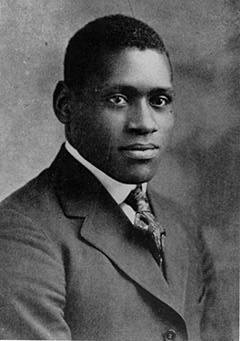
Due to the enormous success of Showboat, Paul and the pianist Lawrence Brown were invited to perform and dine with the aristocracy and royalty of Great Britain. Paul was often treated with the respect of a foreign dignitary, being welcomed by huge crowds as he arrived at train stations. Mayors presented him with the keys to several cities. Taxi drivers often refused payment. “I was treated as a gentleman and a scholar.” Yet in many American cities, he couldn’t even rent a room in a hotel. When on tour, he either had to spend nights at friends’ homes, or in the Black parts of towns, and when visiting his white friends, he had to use the freight elevator.
In 1929, Paul gave his first concert in Carnegie Hall, which was completely sold-out, and gave a repeat performance 5 days later – at which 1,000 people were turned away. He then embarked on a concert tour of the U.S.
In 1930, Paul and Essie starred in a silent, experimental film entitled Borderline, shot in Switzerland. Paul then performed Eugene O’Neill’s play – The Emperor Jones in Berlin.
Robeson’s portrayal of Shakespeare’s Othello in London in 1930 was the first time a Black actor was cast as Othello since Black actors had played Othello in the early 19th century. Robeson stated: “I consider art a social weapon. Not simply for art’s sake do I try to excel in Othello, but more to prove the capacity of the people from whom I’ve sprung, who have erroneously been regarded as backward.”
To prepare for Othello, Paul read virtually everything of Shakespeare. He studied the English language of Shakespeare’s time, and visited London Zoo to study the big cats because he wanted to walk like a panther. Paul approached the preparation for Othello with such intensity that he needed 10-12 hours of sleep per night to recuperate from each day’s rehearsals.
His interpretation of Othello was revolutionary. Othello is an African of noble ancestry. He is a general, a fierce warrior, and a military hero, who finds himself in a hostile White society. Paul spoke about “how difficult, almost impossible it was for a Negro coming out of America, where he was expected to be deferential and humble, suddenly to walk on stage with the assertiveness and confidence of a general.” On opening night, Paul received 20 curtain calls! And the reviews were ecstatic. It ran for 6 weeks, breaking box office records. Paul was paid $15,000 per week.
In 1943, Robeson starred in Othello on Broadway. Unlike London, New York was very afraid of producing a play in which a Black man made love to – and murdered – his white wife on stage. The Broadway production ran for 296 performances, setting – as of 2021 – what is still the record for a Shakespearean play on Broadway. It then toured for the next year throughout Canada and the U.S., excluding the South. More than half a million people saw it. In 1959, he appeared as Othello with the Royal Shakespeare Company in Stratford-Upon-Avon, the town of Shakespeare’s birth.
Paul often included Othello’s final soliloquy in his concerts.
In 1931, Eugene O’Neill requested Paul to play the lead role in the London production of his play, The Hairy Ape. And he was included in the 1931 Britain’s Who’s Who.
Paul enrolled in the University of London’s School of Oriental and African Studies to learn several African languages, including Yoruba, Yu, [Ewe], Eefik, Benin, Ashanti, Swahili, Chuwee [Twi], Tivi, Ga, Howza, and others. He found that learning them was easy because “their rhythm is the same as that employed by the American Negroes in speaking English.”
He befriended several students studying in London, including Jomo Kenyatta, Nnamdi Azikiwe, Kwame Nkrumah, Joshua Nkomo, and Jawaharlal Nehru. They later became the heads of state of Kenya, Nigeria, Ghana, Zimbabwe, and India. Paul supported the West African Students Union. He supported self-government for the West Indies, and assisted West Indian and African students and their families in England.
He learned French, Italian, German, Spanish, Chinese, Yiddish, Dutch, Hungarian, Turkish, Swedish, Norwegian, Czech, Modern Greek, Ancient Latin, Russian, Gaelic and Portuguese. He studied 4 languages simultaneously, spending 12 hours a day listening to language recordings, and studied while in-transit, during rehearsal breaks, and during intermissions at performances. One journalist reported: “He was a prodigious reader, going through 7 books a week. He started studying Norwegian at 8 o’clock one morning, and was writing it by 6 the same evening.” He once turned down a 50-week radio engagement because he was in the throes of learning Chinese. His favorite language was Russian. “I find the language richer, warmer, more fully expressive, more colorful than modern English. The Russian language today is comparable to Shakespearean English—young, forceful and rich.”
He intensely researched the history and culture of Africa. “I have met Negroes in the United States who believed that the African Negro communicated his thoughts solely by means of gestures, that in fact he was incapable of speech and merely used sign language! It is my first concern to dispel this ignorance. I learned that along with the towering achievements of the cultures of ancient Greece and China, there stood the culture of Africa, unseen and denied by the imperialist looters of Africa’s material wealth.” He spoke of “the remarkable kinship between African and Chinese cultures. I found the African way of thinking in symbols was also the way of the great Chinese thinkers.”
In 1937, Robeson donated $1,500 to launch the Council on African Affairs, and became its chairman, together with W.E.B. Dubois. It was dedicated to freeing Africa from colonial rule, and educating African Americans about their roots in Africa. Paul rejected the concept of melting pot assimilation. His view matched that of New York Jewish intellectuals of the early ‘30s, who published their views in the Menorah Journal. He believed African Americans should become “a self-respecting, solid racial unit with its spiritual roots back in Africa.”
Paul said: “The Russian folk songs and those of the Soviet Republics bear a close relationship to folk songs of the Negro people. These songs were born out of the misery and suffering, exploitation and oppression of the people.” In spirituals, he identified the sufferings of African Americans with that of the ancient Hebrews. He often illustrated his point by singing, “Go Down Moses, Let my people go.” “When I sing, “Let my people go”, I can feel sympathetic vibrations from my audience. It is a symbol of those seeking freedom from the dungeons of fascism in Europe today.”
In 1932, Paul sang with the NY Philharmonic at Harlem’s Lewisohn Stadium, performed a benefit for the Harlem branch of the Children’s Aid Society, received an honorary Master of Arts degree from Rutgers University, and performed in a Broadway revival of Showboat.
In 1933, Paul starred in the film version of The Emperor Jones. It was the first time a black actor was cast as the lead in a mainstream motion picture, and it wouldn’t happen again for 25 years.
In 1935, Paul starred in Sanders of the River. The film contained racial stereotypes, yet he accepted the role because “I wanted to show that while the imperialists contend that the Africans are ‘barbarians and uncivilized’, that they have a culture all their own and that they have as much intelligence as any other people. African music has subtleties of rhythm far finer than anything achieved by a Western composer. And I think that the Americans will be amazed to find how many of their modern dance steps are relics of an African heritage. Scholars traced the influence of African music to Europe, Persia, India and China, and westward to the Americas.” To Robeson’s disappointment, the film turned out to glorify British imperialism. Therefore, he donated his salary to fund scholarships and loans to African students, and attempted, unsuccessfully, to purchase the film to prevent its release.
Also in 1935, George Gershwin was composing Porgy and Bess, and had Paul in mind for the role of Porgy. Paul also received an invitation to appear in the Chicago Opera production of Aida. He turned them both down because he didn’t consider his voice to be suited for opera, and wanted to reach a broad audience that didn’t listen to opera. In fact, Robeson announced that classical music would play no further part in his concert programs. He wanted to concentrate on folk music from around the world, which transcended race and nationality. He was excited to discover links between seemingly diverse cultures through the sounds of their languages and songs. “The history of the Russian peasant closely parallels the history of the Negro peasant in America, and in the music, there is the same note of melancholy. I have occasionally found whole phrases of Russian music that could be matched in Negro melodies.”
Robeson said that he “had always felt an almost mystical connection to Jewish people.” As a boy, he listened to his father and his brother Ben reading Hebrew together. He observed that their Jewish neighbor was one of the first white people to treat his father with respect. His roommate in college was a Jew who, at Rutgers, was considered less than white. Paul’s wife Essie was a Black Spanish Jew. And in interviews, Paul often spoke about how much Jews had helped him as a young man. “The Negro spiritual and the Hebrew chant have the same plaintive note. Both of our peoples have known oppression, and I feel at home singing in Hebrew.” He often explained that the African American slaves identified with – and were inspired by – the ancient Hebrews. The liberation theme struck so deeply—the Moses story, the Daniel story, the Joshua story.
Paul assisted the American ORT organization, which offered instruction in various trades to young Eastern European Jews preparing to emigrate to Palestine. In 1933, thousands of Jews fleeing Nazi Germany were arriving in London. Paul donated his fee from a benefit performance of All God’s Chillun Got Wings, which raised $10,000 for the refugees. “The white people who have been kindest to me in America have been Jewish people.” In 1936, Paul donated to a group of German Jewish expatriates whose objective was to expose the truth about Nazism through their publication Germany Today: Inside Germany. “I realized that the suffering of my own people was related to the sufferings of equally oppressed minorities. The Negro and the Jew have the same enemy: fascism. You can always count on my help and solidarity.”
The film director Herbert Marshall recalled “Robeson wore a yarmulke when he studied, and asked me to teach him the Kaddish”. What Robeson called the “Hassidic Chant,” is known as “The Lawsuit with God”. It is a complaint directly to God followed by chanting the Kaddish. It is a song of protest and an affirmation of faith. Robeson described it as “a protest against age-old persecution, a ‘Kaddish’ that is very close to my heart, that means much more than just another song. I sing it at almost every concert that I do.”
At the end of 1934, Paul and Essie made their first visit to Russia. They traveled from London to Moscow, with a stop-over to change trains in Berlin, where they found storm troopers and swastikas everywhere. As they prepared to board the train for Moscow, a group of brown-shirted Nazis approached with hatred in their eyes. Paul thought: “This is how a lynching begins.” Afterwards, he said “The day I spent in Berlin was a day of horror—in an atmosphere of hatred, fear and suspicion. I never knew what fascism was before. I’ll fight it wherever I find it from now on.”
Paul was known in Russia through his recordings. During the 2-week visit, the Robesons were wined and dined by cultural and political leaders. Paul captivated everyone with his perfectly fluent Russian and his impromptu singing. Their schedule was packed with parties, plays, operas, banquets, and visits to factories, hospitals, and children’s centers. Paul was struck as he observed workers of different races working side by side as equals. At that time, Russia was the only country that made bigotry a punishable crime. The Robesons learned from several African Americans living and working in Moscow that there was no racial prejudice in the Soviet Union. Paul repeatedly stated “In Soviet Russia, I breathe fully for the first time in my life. Here, for the first time in my life, I walk in full human dignity.”
Robeson was impressed that children of illiterate peasants could become teachers and scientists, that there was free healthcare for everyone, and by the establishment in the Far East of a Jewish national region in Birobidzhan, Paul was especially excited about the Jewish Theatre, which was rehearsing Shakespeare’s King Lear in Yiddish. The Robesons even enrolled their son in an elementary school in Moscow, where the boy lived with Essie’s mother for two years, and where one of his classmates was Stalin’s daughter.
In early 1936, Paul helped finance an anti-apartheid documentary about South Africa, entitled My Song Goes Forth, in which he sang 2 songs, and narrated the prologue.
That year in London, Paul starred in C.L.R. James’s play, Toussaint L’Ouverture, the Haitian liberator, who led the only successful slave revolt in history. In the U.S., he appeared in the first film version of Showboat, and sang 12 concerts in Moscow, Leningrad, Kiev and Odessa, which were broadcast throughout the Soviet Union.
In London in 1937, Paul sang and spoke at benefits to support Chinese resistance to the Japanese occupation, and spoke at a large meeting to protest the conditions in Jamaica.
The Spanish Civil War began in 1936 when the fascist general, Francisco Franco, fought to overthrow the recently elected government. While Hitler and Mussolini assisted Franco, the Soviet Union began sending aid to the government of Spain, and proposed the formation of an international volunteer army to fight against the fascists. More than 40,000 people from 52 countries enlisted in the International Brigades. The Abraham Lincoln Brigade had 3,200 American volunteers, 90 of whom were African Americans, and was the first fully integrated military unit in U.S. history. Some African Americans served as officers with whites under their command. Paul initiated a fund for the relief of the dependents of those African Americans, and donated generously to the Negro People’s Ambulance for Loyalist Spain.
After the fascist bombing of Gernica, Paul appeared in London’s Royal Albert Hall at a huge rally to aid Spanish Refugee Children. Paul called the fight against fascism “the greatest cause which faces the world today. Every artist, every scientist, every writer must decide now where he stands. The artist must take sides. He must elect to fight for freedom or slavery. I have made my choice. I had no alternative.”
Those words are the epithet at his grave. Five months later, he again appeared at Royal Albert Hall to raise funds for the victims of the Spanish Civil War.
At the beginning of 1938, Paul and Essie traveled at great personal risk to 6 Spanish cities. Paul sang defiant songs in Spanish that were amplified by outdoor loudspeakers for the ears of the loyalists and the fascists. Both sides briefly suspended the fighting to listen! He sang for wounded volunteers at hospitals, signed autographs, and accepted messages from the troops for their families. Throughout 1938, Paul continued to sing and speak for the benefit of the Spanish cause. Paul called the trip to Spain “a major turning point in my life.”
By 1938, Paul had vowed to only accept movie scripts about ordinary people. He donated his services, and helped establish London’s Unity Theatre, which produced plays to make working people conscious of their power, and of the need for unified action. He and Larry began performing 3 shows per day for reduced artist fees, and at affordable ticket prices.
“In many lands, the arts, and especially music, have become the source of enjoyment for a comparatively few, so-called elite. All my concerts in the future will have a 5 shilling top admission fee. I will go on stage as a representative of the working class to sing the songs of farmers, workers, miners, road-diggers, and chain gang laborers. They understand the common language of work, suffering and protest.”
In 1929, Paul had encountered a group of out-of-work miners from South Wales who had walked all the way to London to seek assistance from the government. Paul joined the group and made their return to Wales by train financially possible, and sent them home with food and clothes. He visited and sang for them in Wales. He later starred in The Proud Valley, a film about the Welsh miners. It shows the greed of the mine owners, and the apathy of the British government. The poor working conditions in the mines reminded Paul of the intolerable conditions of his relatives on the tobacco plantations in North Carolina and the coal mines in West Virginia. It is the only one of his films that he was proud of.
Joe Hill was a copper miner in Salt Lake City, Utah, who was a poet and union activist. In 1915, he was framed on a false murder charge and assassinated. Paul sang the song Joe Hill throughout his career at union rallies and at his concerts. He sang it for the Welsh miners in the film The Proud Valley.
In London, in 1935, Paul starred in the play Stevedore about the battle of black dockworkers to unionize and fight racial oppression.
Also, in 1939, Paul narrated – gratis – the documentary Native Land, about the struggle of trade unions, containing a graphically violent opening scene.
Robeson joined innumerable picket lines throughout the U.S., and became an honorary member of several unions. In 1941, he supported the United Automobile Workers against the Ford Motor Company, and he sang and spoke at the National Maritime Union convention.
In 1939, Larry and Paul performed in Oslo, Copenhagen and Stockholm, followed by a return to the U.S. for several concerts, and a week-long production of The Emperor Jones.
At the end of 1939, Paul sang Earl Robinson’s Ballad for Americans on a live radio broadcast. His recording of it quickly rose to the top of the charts. It became so popular that it was even dubbed the unofficial national anthem.
Next, Paul began rehearsing for the Broadway musical John Henry, about the legendary Black folk hero.
In 1940, Hamilton College awarded Paul an honorary doctorate degree. He also appeared at a rally for the China Defense League, and joined the board of the Negro Playwrights’ Company. He appeared in a revival of Showboat in Los Angeles, and sang a concert tour including an appearance in Harlem with the NY Philharmonic at Lewisohn Stadium, in Chicago’s Grant Park, for 165,000 fans, and at a sold-out performance at the Hollywood Bowl.
Robeson starred in more than a dozen movies, such as The Emperor Jones, Song of Freedom, King Solomon’s Mines, Jericho, and Big Fella, but he was frustrated about the stereotypical depiction of Black characters. For the film, Tales of Manhattan, he was told he’d be able to make changes in the script. When that promise was not kept, he tried to buy his way out of the contract, but couldn’t afford it. Robeson said that he would join any picket line that might develop during its NY showing, and held a press conference to announce that he was quitting Hollywood for good because “the industry didn’t realistically portray the plight of Blacks and other oppressed groups.”
During World War II, Paul performed at war-bond rallies and for the troops. He encouraged African Americans to support the war, warning that “the victory of fascism would make slaves of us all.” Robeson called for the end of discrimination in the defense industry and in the military.
In the early 40s, Paul was earning up to $2,500 per concert, but turned down many lucrative offers because he refused to perform for segregated audiences, and his contracts prohibited discrimination in seating or in ticket sales.
In October of 1942, Larry and Paul began a 6-month concert tour of the U.S. and Montreal, performing 70 concerts. Robeson then appeared at the Southern Negro Youth Congress in Tuskegee, AL and with Eleanor Roosevelt at the Southern Conference for Human Welfare in Nashville, TN.
Paul had become the most famous Black man in the world. His 46th birthday celebration in 1944 was held at an armory in New York City for 12,000 people. Four thousand (4,000) were turned away at the door. Among the guests and well-wishers were Cab Calloway, Joe Louis, Babe Ruth, Count Basie, Jimmy Durante, and Duke Ellington.
In 1943, Robeson spoke at a Free India mass rally, and at Yankee Stadium at a Labor for Victory rally. He gave the commencement speech at Morehouse College, which awarded him an honorary doctorate degree. He sang again with the NY Philharmonic at Lewisohn Stadium, in Chicago at a Production for Victory rally, in Los Angeles for a rally to benefit the Joint Anti-Fascist Refugee Committee, and in San Francisco, at the conference on racial and national minorities sponsored by the Congress of Industrial Workers.
In 1943, he met with the commissioner of baseball and the major-league club owners to advocate for the inclusion of African Americans, which resulted in Jackie Robinson becoming the first to break that barrier, playing for the Brooklyn Dodgers.
In 1945, Robeson was the recipient of an honorary doctorate degree from Howard University, and the Spingarn Medal from the NAACP.
At the beginning of his career, Paul believed he could best contribute to the advancement of his race through his artistic achievements, rather than through militant activism. He gradually came to realize how little his personal achievements benefited the status of his race, and that he couldn’t be of true service to his people through art alone. “Einstein is the greatest mathematician that ever lived, but that didn’t save the Jews from Hitler.”