By Michael Laster
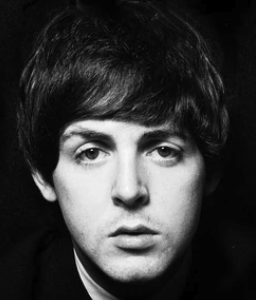
James Paul McCartney was born on June 18th, 1942, in Liverpool, England to Jim McCartney, a cotton salesman, and Mary Mohin, a nurse. Paul’s younger brother, Mike, was born a year and a half after him. Paul didn’t know his grandparents, but he had a large, tight-knit extended family through uncles and aunts from his father’s side.
Paul’s father Jim was an amateur self-taught musician who led a dixieland and ragtime band in his youth, and would regularly play piano during lively family gatherings. Paul remembers his dad playing the introduction to Gershwin’s “Stairway To Paradise,” while attempting to explain why the chord progression was clever. Jim even wrote a song called Walking in the Park with Eloise, later recorded by Paul in 1974. However, Jim was very modest about his abilities, believing that real songwriters lived in New York and London. In terms of the creation of his tune, he claims he didn’t write it, he merely “made it up!”
Jim tried to get Paul to take piano lessons with a professional, but Paul quickly lost interest, complaining that his teacher’s home “smelled like old people.” To this day, Paul doesn’t know how to read or write music, preferring for music to be intuitive.
Corporal punishment was not uncommon at the time, and Jim was known to hit and spank as a form of punishment, the only downside to a seemingly ideal childhood. Paul remembered the day he was able to stand up for himself.
At an early age, Paul was praised for his singing voice, often singing harmonies along with songs playing on the radio. Paul also thrived in school and the boy scouts. At age ten, in spite of his modest working-class background, he was admitted to the Liverpool Institute High School for Boys, the most prestigious of its kind in Liverpool. Luckily, admissions were free, and based on merit alone.
Paul was quite popular in school, drawing caricatures of teachers and fellow classmates, and imitating all the voices he heard on various episodes of the Goon Show, a comedy show led by Peter Sellers. Sadly, Paul’s near-perfect streak of happy memories would not last. While he and his brother were away at camp, his mother started feeling pain in one of her breasts. By the time she had it diagnosed, the cancer had already metastasized. She died in the hospital in 1956 at the age of 47. Paul was just 14. He remembered, “We had no idea what my mum had died of because no one talked about it. She just died. The worst thing about that was everyone was very stoic. Everyone kept a stiff upper lip, and then one evening, you’d hear my dad crying in the next room. It was tragic, because we’d never heard him cry. I was determined to not let it affect me. I carried on. I learned to put a shell around me.”
It was during this year that Paul, in addition to many other teenagers, became mesmerized by rock and roll. Elvis, Little Richard, and Chuck Berry were dominating the radio, and a month after his mother’s death, Paul decided to trade in the trumpet that his father had given him as a birthday present for a guitar. Being left-handed, Paul restrung the guitar and flipped it over.
Shortly after teaching himself guitar with the help of his friend Ian James, Paul was invited to see a performance of the Quarrymen outside of St. Peter’s Church, led by John Lennon. Paul was already familiar with John, and up to this point had steered clear of him due to John’s aggressive reputation. However, after the Quarrymen’s performance, where John made up many nonsense lyrics to many of the songs, Paul played and sang Twenty Flight Rock for John on guitar, and then went over to the church’s piano to perform A Whole Lotta Shakin Goin’ On by Jerry Lee Lewis. John was impressed, but faced a dilemma. Priding himself on being the leader, he didn’t want Paul to overshadow him, but he decided to invite him into the group for the music’s sake, knowing that he could learn from Paul. Being the new member, Paul helped tighten up the band’s musicianship, but was sure not to overstep John’s authority. In addition to Paul’s friendship with John, Paul’s closeness to George Harrison was also growing. George was a schoolmate a year behind Paul whom he overheard practicing guitar on the school bus. Paul eventually persuaded John to let George join the Quarrymen despite John feeling like he was too young looking.
Two years after Paul lost his mother, John’s mother Julia was fatally struck by a car in 1958. Even though Paul understood John’s pain, the two didn’t really talk about it due to British conventions at the time about maintaining a stiff upper lip in the face of adversity. However, it did strengthen the bond between them.
Paul’s girlfriend, Dot Rhone, became pregnant with Paul’s child. It was agreed between their families that they would get married. However, three months into the pregnancy, she suffered a miscarriage. Paul rushed to her bedside with flowers, but was secretly relieved that he wouldn’t have to give up music to find a so called proper job in order to be a responsible father. At the Liverpool College of Art, John befriended fellow student Stu Sutcliffe. Soon, his bond with Stu was closer than his friendship with Paul. He asked Stu to join the Quarrymen as bass player, in spite of Stu having virtually zero musical talent, which deeply frustrated Paul. At this time, Not too long after Stu’s arrival, they received an offer to play in Hamburg’s Reeperbahn, its infamous red light district. Paul had to made the difficult decision to drop out of school in order to go. Paul’s father was not pleased, but gave in. Needing a drummer, they hired Pete Best whose mother was the owner of a cafe they performed in. At this point, after several changes of names for the band, they settled on The Beatles.
During their first residency in Hamburg, they were at their wildest and raunchiest, performing up to eight-hour sets behind comedians, strippers and headliners, playing covers of popular songs. Back at home in Liverpool, they amassed a following at the Cavern Club. It was during this early period that Paul wrote fragments of, and complete versions of songs that would later find their way into their catalogue, such as I’ll Follow the Sun, and the verse to Love Me Do. There’s a lesser known song of his called The Love of the Loved, written around 1959, and recorded three years later as an audition for Decca Records.
During their second residency in Hamburg, Stu quit the band out of a desire to pursue art, leaving Paul to take over on bass. Initially after playing Stu’s bass upside down, Paul ended up buying a Hofner violin-shaped bass guitar. He chose this particular model because it was symmetrical, and he originally intended to play it upside down. However, the shop owner offered to put in an order for a custom made left-handed model. Paul launched this bass model into prominence, making it Hofner’s best-selling instrument of all time.
In 1962, the Beatles signed with their manager, Brian Epstein, the owner of a successful music store in Liverpool. Not too long after signing with producer George Martin of Parlophone Records, the Beatles had a chance to meet and tour with one of their foundational idols, Little Richard. Richard spoke highly of Paul, George, and Ringo, but took a disliking to John because of his cruel pranks, such as locking Richard in his dressing room. Out of all of the Beatles, it was Paul who was known for his imitation of Richard, which eventually stopped being an imitation, and simply became one of Paul’s several trademark vocal timbres.
In the early days, Paul and John were equally talented as songwriters, and it can be difficult to delineate any noticeable difference in their songwriting, especially since they wrote most of their songs together, and shared most of the same musical influences. A key exception, however, was Paul’s love for vaudeville, British music hall, and songs from musicals. According to John, “Paul was more advanced than I was. He was always a couple of chords ahead and his songs usually had more chords in them. His dad played the piano. He was always playing pop and jazz standards and Paul picked things up from him.” As the Beatles evolved, a clear dichotomy emerged between the two, especially as Paul gained confidence as a songwriter and became less self conscious about his songs being labeled as sappy. For John, corniness was to be avoided like the plague, unless done ironically. For Paul, largely through his father’s taste, a good melody was a good melody, regardless of the lyrics. Lyrically, John’s early songs, when not the standard theme of “I Love You”, often contained themes of jealously, insecurity, and damaged pride, whereas Paul’s lyrics, when not generic love sentiments, were about sorrow, as in Yesterday, or frustration as in You Won’t See Me. It should be noted that while John and Paul’s personalities and feelings leaked into their songwriting, they saw themselves as craftsmen like any traditional songwriting team. Two of Paul’s best known songs from this early period include I Saw Her Standing There, and All My Loving.
Paul and John were generally in total lockstep as songwriters. But from the beginning, Paul’s talent as a musician stood out from the others in three significant ways. First, was the quality of his voice. Neither George or John could pull off the pure tone Paul achieved on their version of Till There Was You from The Music Man. Paul was a natural harmonizer because his voice sits comfortably in the upper range of the vocal spectrum. He is a tenor, whereas George and John were baritones. Whenever they would sing three part harmony, like in Nowhere Man, This Boy, or If I Needed Someone, Paul is always on top. Secondly, Paul was also the first prominent rock bassist to sing while playing. Before Paul, it was virtually unheard of for bassists to effortlessly split their attention between their bass and their singing, especially the fast-paced walking bass that Paul mastered early on in Hamburg. Such a feat is generally more difficult than it is to sing while strumming the guitar to a uniform rhythm. Third, based on audio of their recording sessions, Paul seemed like the one who gave directions to the other three. While their producer George Martin wrote arrangements whenever classical instruments were used, and made suggestions about the structures of the songs, Paul appeared like the de-facto music director within the band.
In 1963, Paul met the Shakespearean actress Jane Asher, who came from a wealthy, well-educated family. He impressed her with his knowledge of quotes from Chaucer’s The Canterbury Tales, and after befriending her parents, moved into a room in her family’s home. To dodge being mobbed by fans outside the Asher residence Paul would sneak through the neighbors’ house, with their permission, of course. Allegedly, Paul wanted Jane to give up her career to be a housewife, but Jane refused. This created some tension in the relationship, but they managed the best they could.
Still close with his father Jim, Paul, now a millionaire, bought him a racehorse for his 62nd birthday, and gifted him enough money to retire early. The McCartney home was also surrounded by fans, who Jim would always be happy to invite in for tea. However, by 1964, the mobs of young women were so out of control that Paul could no longer safely visit. He bought Jim a new home in a more remote area, and paid for the renovation.
The highlights of Paul’s output from 1964 include his songs on the album A Hard Day’s Night, such as Things We Said Today, And I Love Her, and Can’t Buy Me Love.
In interviews, Paul was known for being charming, affable, and less sarcastic than John, though when he was sarcastic, there wasn’t any underlying bitterness or cynicism. In fact, unlike John, true anger seemed rare in Paul, and at the worst, would come out as frustration or annoyance, but never personal attacks. In some ways, this contrast in temperament made some brand John and Paul as complementary Yin and Yang, which is true in some ways, but overall, their commonalities outnumbered their differences.
Paul also wrote songs for other artists, like Jane’s brother Peter, who was part of the duo Peter and Gordon. He wrote four songs for them, including A World Without Love and Woman. He also wrote It’s For You for fellow Liverpudlian Cilla Black.
It wasn’t until the 1965 album Help! that Paul did something that completely separated himself from the other three. He woke up one morning with the melody to Yesterday in his head, and was sure he had heard it somewhere else. After being convinced by everyone he played it to that it was indeed original, it was decided that no contributions from the other three Beatles would be needed, marking the first time a Beatles track didn’t include any of the other three. George Martin masterfully arranged the strings,
Paul’s contributions to the Rubber Soul album include Drive My Car, I’ve Just Seen A Face, You Won’t See Me, I’m Looking Through You, and Michelle, the only Beatles song to win the Grammy for Song of the Year in 1967, two years after its release.
At the end of 1965, Paul was involved in a moped accident where he fell on his face, busting open the top part of his lip, and chipping his tooth. The chipped tooth can be seen in the video for Paperback Writer. The tooth was repaired, but he was left with a lip scar ever since.
John, branded as the most artsy and intellectual Beatle, ended up taking a back seat to most of London’s artistic underground scene. Paul was the most active in this regard, befriending John Dunbar and Barry Miles, helping them create what became known as the Indica Bookstore and Art Gallery. He also met with the English philosopher, Bertrand Russell, to briefly discuss the Vietnam War. In terms of music, Paul became interested in the works of experimental classical composers like Karlheinz Stockhausen, Luciano Berio, and Edgar Varese, which helped inspire the use of experimentation on their upcoming album, Revolver.
1966 was a breakthrough year for the Beatles creatively. Paul played a key role on just about every song on the album, from the iconic bassline and guitar solo on George’s Taxman, to the guitars on And Your Bird Can Sing, piano on I Want To Tell You, and the tape loops on Tomorrow Never Knows. Paul’s songs from Revolver include Eleanor Rigby, Good Day Sunshine, Got To Get You Into My Life, For No One, and Here, There, and Everywhere, which he considered to be one of his best songs.
After the Beatles decided to stop touring, they all briefly took a break to pursue their own projects. Paul helped write a short melody to underpin the score to the Haylee Mills’ film, The Family Way. George Martin then wrote variations on the melody, and helped score the entire film.
When they returned to the recording studio, they worked on John’s song, Strawberry Fields, for which Paul created the famous Mellotron intro. In response to John’s song about his favorite childhood location, Paul wrote Penny Lane.
Next on the agenda was their monumental album, Sgt. Pepper’s Lonely Hearts Club Band. For this album, Paul proposed that the band adopt alter egos, and write in any style, thus freeing them from the youth-oriented image of the Fab Four, and establishing their new brand as mature artists. It also gave Paul an excuse to finally embrace the musical influences that came from his father. Producer George Martin played the vaudevillian piano solo to Lovely Rita, and arranged the brass band for the title track. Paul wanted an orchestral arrangement for She’s Leaving Home, but Martin was busy recording another artist. Now used to getting what he wanted when he wanted it, Paul hired another arranger to write the accompaniment for harp and strings.
This hurt George Martin, and as we’ll see, it wasn’t the only time Paul’s ambition caused him to unintentionally overlook the emotions of those around him. Paul’s only song without George Martin’s orchestrations was Fixing A Hole.
The song When I’m 64, was one of Paul’s oldest melodies, from before he met John. Many speculate that he eventually wrote the lyrics to this tune for his father’s 64th birthday a few months earlier, though Paul himself never confirmed this theory. George Martin wrote the accompaniment for clarinet trio.
It’s at this point that Paul reached maturity as a bass player. He was inspired by James Jamerson’s bass parts on Motown recordings that had their own melodic independence. From the beginning of his career, Paul’s bass lines had evolved from being tasteful, yet ordinary, to being a secondary melody that complements the vocals without distracting from them.
When it came to the iconic cover of the Sgt. Pepper album, Paul received help from several other artists and designers to work out the details, but the concept was largely his. Some fans speculate on two sources of inspiration. One is the cover of a Swedish Brass band that played Beatles songs from 1964, three years before Sgt. Pepper. And here’s a picture of Paul’s father, Jim, with his old jazz band, surrounded by friends. There’s no proof that either of these pictures provided direct inspiration for the cover, but the photo of his father’s band provides some potential symbolism of what Sgt. Pepper meant to Paul.
By fully embracing his influences from childhood, with the help of George Martin’s arrangements, Paul was creatively unstoppable. Now there was nothing in the way of him writing in any style he chose.
Starting with the string quartet on Yesterday, followed by George Harrison’s sitar on Rubber Soul, the Beatles reached the peak of expanding the definition of what a rock band could be. As we’ll see in Part 2, Paul’s growing independence within the group may have been one of the factors that eventually led to John’s desire to seek independence from the group. But for now, the four of them were still as close as could be. In fact, when it came to their creative trajectory, Sgt. Pepper proved to listeners that, even though they were no longer putting on concerts, their work in the recording studio seemed to be getting better, one album at a time.